Why Court Lines Change the Way a Game Unfolds
Why court lines change the way a game unfolds: learn how boundary and service markings shape play, and how to read the layout before taking a position.
The common mistake is to treat every painted court line as a boundary, then argue over a ball that was never meant to be judged by that mark. The cost is practical as well as social: players move into the wrong space, serve from the wrong place, or stop play when the rules say it should continue. Understanding why court lines change the way a game unfolds begins with asking what job each line does.
A court is not simply a rectangle with a border. Its markings assign different meanings to areas: some define the field of play, some constrain a serve, and others divide teams’ responsibilities. The same patch of floor can matter differently according to the sport, the phase of play and the line being considered.
Start with the sport and the phase of play
Before deciding whether a ball is in or out, identify the sport and the action underway. A service box may govern where a serve must land, while the surrounding court remains relevant once a rally has begun. A boundary line may count as part of the playing area in one game, while a separate line has a different role in another.
This is why borrowing an interpretation from a familiar sport can mislead. Tennis, badminton and volleyball all use court markings, but their lines define different spaces and actions. Even within one sport, the relevant area can change between singles and doubles, or between service and open play.
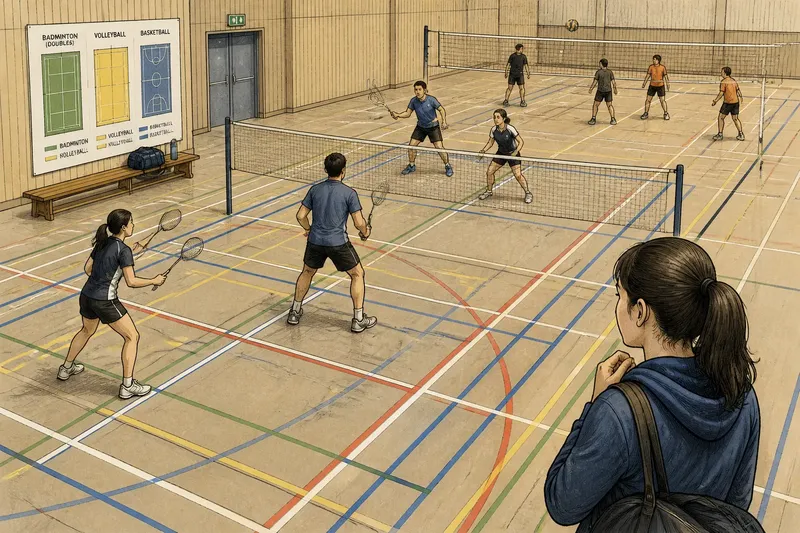
If you are new to a venue, look for the sport’s name on the court plan or ask the organiser which markings apply. Where several games share a floor, coloured lines may overlap; colour alone is not a reliable guide unless the venue identifies what each colour means.
Choose your reading by the situation
The useful question is not simply “Which line is this?” but “What is happening here?” The answer points you towards the marking that matters.
- If play is starting with a serve, look first for the service area and the required direction or destination. Those markings organise the opening action rather than necessarily describing the full boundary for the rally.
- If a ball is near the outside edge during a rally, identify the sport’s active court boundary and check whether the line itself belongs to the playing area. Do not substitute a nearby service or centre line for the outer limit.
- If doubles or another team format is in use, check which side or lane is active for that format. Some layouts use additional width or other zones, so the singles boundary may not settle the call.
- If the court is shared or temporarily marked, ask which game’s layout has priority and whether temporary tape changes the usable area. This prevents one group from applying a permanent marking that belongs to another activity.
- If you are watching from the side, follow the players’ positions and the next action, not just the nearest painted line. A line can look prominent while having no bearing on that particular phase.
For example, imagine a beginner arriving at a multi-use hall where badminton and volleyball markings cross. Before a casual badminton game, they ask the organiser which colour marks the badminton court and whether the outer doubles lines are in use; the expected observable result is that players take positions on the intended layout and can judge a close shot against the same boundary.
When do service lines and boundary lines matter?
Does a service line mark the edge of the whole court?
Usually, a service line defines a particular service zone or limit, not the complete boundary for every exchange. Its relevance depends on the sport and whether the serve is being played or the rally has begun.
Does a ball touching a line count as in?
That depends on the sport’s rules and on which line is being judged. A boundary line may be included in the playing area, while a service marking can have a different interpretation; check the relevant rule rather than assuming all painted lines work alike.
Why are there several boundary lines on one court?
Shared facilities often host more than one sport, and a single sport may also have different layouts for singles, doubles or another format. Separate markings let those arrangements coexist, though the venue needs to make the active layout clear.
What should I do if two markings seem to conflict?
Pause and establish which sport and format are being played, then identify the corresponding court lines with the organiser or the posted court plan. If the group cannot agree, settle the interpretation before resuming rather than changing it after a disputed point.
Read the lines as zones, not decoration
Once you know the active layout, each marking can be read as an instruction about space. An outer boundary tells players where a ball may remain playable; a service box identifies a target or limit for the opening shot; a centre line can separate responsibilities or direct the service. These functions are related, but not interchangeable.
Zones also shape anticipation. A player serving towards a defined area must place the ball with that target in mind, while the receiver prepares for the likely return. During a rally, the boundary influences whether a player can let a ball pass or needs to reach it. The lines therefore affect movement before anyone makes a call.
For a spectator, the same reading makes play easier to follow. Notice which area a player is trying to reach and which edge they are protecting. Rather than memorising every marking at once, track one action: where the serve must go, where the receiver stands, or which outer line could end the exchange.
Shared courts need a clear active layout
In a sports hall, overlapping lines are a design compromise. A basketball court, badminton court and volleyball court may each need a distinct shape, and repainting the floor for every session is not always possible. The result can be visually busy, especially when several colours have similar contrast.
For players, a short agreement at the start of a session is more useful than a long debate after a close call. Confirm the sport, the format, the active boundary and any temporary changes. If tape or portable equipment creates a new line, make sure all players know whether it is a marker, an obstacle or an actual limit of play.
For organisers, signs or a simple court diagram can make this agreement easier. A diagram should identify the sport and format, not just list colours; colour labels are of little use if players cannot tell which set they describe from their position on the floor.
Choose the right way to settle an uncertain line
For a club match, use the sport’s rules and the agreed format. For a school or community session, the organiser may explain a simplified arrangement, but that arrangement should be stated before play. In informal games, players can agree on a workable interpretation together, provided they apply it consistently to both sides.
Line visibility matters too. Dust, glare, worn paint or a net post can make an edge difficult to judge. If visibility is the problem, move to a clearer part of the facility or ask staff whether another court is available; do not invent a new boundary in the middle of a game without agreement.
Where the right interpretation depends on a rulebook, venue policy, manufacturer’s marking system or local competition requirement, check that source once before play. A qualified official or organiser is the right person to consult when a formal match has a disputed layout.
For a quick way to understand why court lines change the way a game unfolds, trace one point from its start to its finish: identify the service zone, then follow the active boundary as the rally develops. That small habit reveals which markings shape the action and which belong to another game, so the court becomes easier to read without assuming every sport draws its playable space in the same way.