From Hand-Timed Rounds to the Modern Match Clock
From hand-timed rounds to the modern match clock, learn how timing rules, displays and stoppages shape decisions in organised sport.
The common mistake is to treat the match clock as a neutral scoreboard accessory. In a timed contest, that can cost a team the chance to manage a lead or organise a final attack. The history of the match clock is not one universal march from a watch to a display; different sports adopted visible clocks under different rules and for different purposes.
Hand timing left the official in charge of the signal
Before a visible display became familiar in many organised competitions, an official could use a watch to track a period and signal its end. The watch supplied a reference, but players and spectators might not be able to see the time remaining. The official’s signal, rather than a public countdown, made the ending clear.
This method should not be mistaken for a single historical system shared by every sport. Rules differed over what counted as playing time, how interruptions were handled and who had authority over the period’s end. A common account of time therefore depended on both the timekeeper and the rules governing the contest.
Visible clocks developed differently across sports
There is no single adoption date or sequence that explains the appearance of the match clock everywhere. Sports and competitions introduced public displays in different contexts; in some, the clock made the remaining time easier to follow, while the governing rules still defined how play ended. A display could make time visible without transferring authority from the officials.
That distinction remains useful. A scoreboard may show a countdown, count up from the start of a period, or display several timers at once. The display’s format tells spectators how information is presented, but the competition’s rules determine what the information means.
A visible clock changes the choices teams can read
Once teams and spectators can see the time, players can adjust the pace without waiting for an official’s signal. A coach can call for possession or urgency, and the crowd can anticipate the close of a period. The clock does not choose a tactic, but it makes the trade-off harder to ignore.
A team protecting a lead may prefer controlled possession, while its opponent may seek a quick restart and a direct route towards scoring. The visible display makes those competing aims legible to everyone, even though officials retain control over timing decisions.
Stoppage rules explain what the clock measures
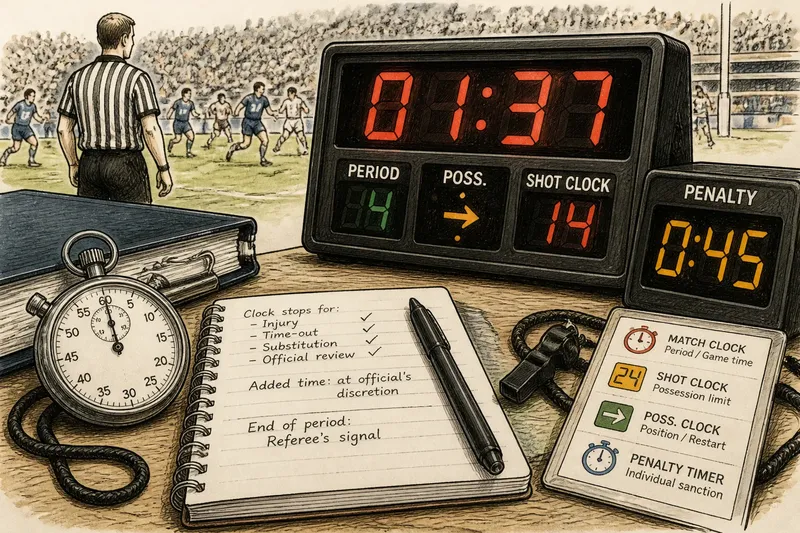
A match clock may track elapsed period time or playing time, depending on the sport and competition. Some displays continue during interruptions; others pause for specified events. Added time, time-outs and timed penalties make different distinctions between a scheduled period and the time when action is live.
Near the end, an injury, substitution or review can leave players unsure whether time continues, pauses or will be supplemented later. The rulebook and the venue’s timing procedure provide the answer; the numbers alone do not. When a display and an official’s signal seem to conflict, the competition’s procedure for resolving that conflict matters.
Say a team is defending a lead and the clock stops for an injury. Its players use the pause to hear the coach and reset their positions, then wait for the official’s signal before restarting. The observable result is that both sides are set for play, rather than acting on a guess about whether the interruption consumed playing time.
Different displays create different kinds of pressure
A countdown makes the approach to zero visible, while a count-up display may leave the period’s end dependent on a separate whistle or signal. Neither design tells the whole story: players need to know which official signal ends play and whether the display can be adjusted.
A shot clock, possession clock or timed round can sit inside a larger match clock. These shorter limits govern a particular action rather than the whole contest. A team can have time left in the match while its current possession limit is nearly over.
To read several displays, identify what each one measures before drawing a tactical conclusion. A period clock, a possession limit and a penalty timer answer different questions, even when they appear side by side.
What should you look for when reading a match clock?
Does the clock stop whenever play stops?
No single practice applies across all sports and competitions. Check the rules for which events stop the clock; if ordinary interruptions do not qualify, do not treat every pause in play as time removed from the period.
What does added time account for?
Added time extends a period under that sport’s rules to account for interruptions. It need not match every inactive second exactly, so read it as an application of the competition’s procedure rather than a simple replay of stoppage duration.
Why might an official’s timing differ from the display?
The display is a tool, while the competition rules set the official timekeeping authority and the procedure for a malfunction or discrepancy. Follow the announced ruling and the competition’s process rather than treating the visible number as an independent verdict.
Is a shot clock the same as the match clock?
No. A shot clock limits a particular attacking sequence, while the match clock tracks a period or the contest as a whole. Check which timer governs the next decision: a team may have match time remaining but little time left in its current possession.
Read the display alongside the officials
When following a match, notice whether the display counts down or up, which timer is running and what signal confirms the end of a period. Watch the referee and timekeeper as well as the changing number; the display is one part of the timing system.
The same habit helps players. A team can agree on a cue for changing from patient possession to an urgent attack, but that cue should fit the actual stoppage and restart rules. A plan based on an assumed procedure can unravel even when the countdown appears clear.
Timekeeping gives the contest its boundaries
Rules and officials establish the boundaries of a timed contest; a visible clock makes those boundaries easier to follow and turns remaining time into a tactical consideration. Its effect depends on the sport’s rules, the display and the signals that govern play.
To understand the modern match clock, first identify what its display counts and then check which official signal makes that time decisive. That small distinction helps a spectator read the next decision—and helps a player avoid acting on a number alone.