A First Visit to an Indoor Arena: Read the Room Before Play
A first visit to an indoor arena feels easier when you read entrances, sightlines, seating zones and the court’s relationship to the crowd before play.
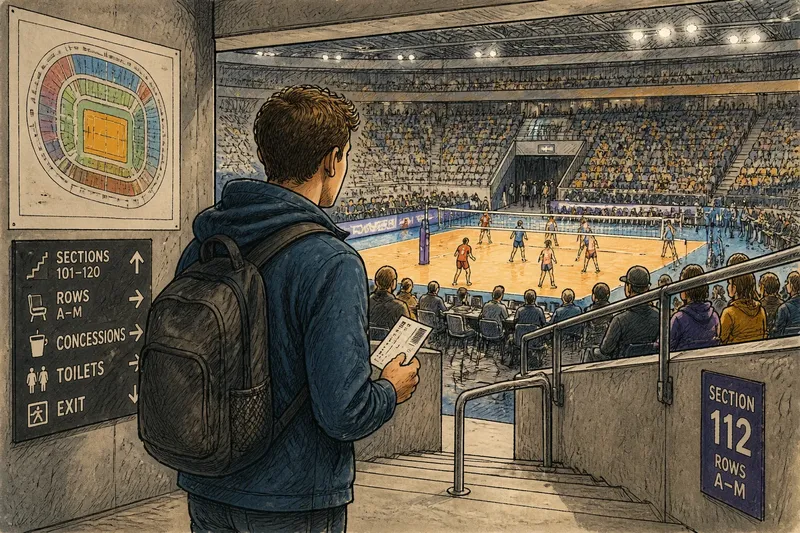
The most common mistake on a first visit to an indoor arena is heading straight for the nearest open seat. It can leave you facing a barrier, looking across a busy walkway or unsure where players and officials enter; a short pause at the entrance helps you choose a place with a clearer view and fewer interruptions. Reading the room is part of understanding the game’s setting, not a test of arena knowledge.
Start by finding the public entrance and the route to your seat
Before moving into the seating bowl, look for the signs that separate public access from team, staff and service areas. A venue map, ticket information or directions from an usher can identify the right entrance without requiring you to guess from an open doorway. Keep your ticket available, since seat blocks and rows may be reached from different concourses.
Notice whether the arena has one continuous concourse or several levels joined by stairs, ramps or lifts. The nearest opening may lead to a section that is convenient to enter but awkward for your assigned seat. Follow the section and row markers first, then step into the seating area where the route is clear.
If you arrive before play, take a moment to see how people move between the entrance, concessions and seats. Crowds tend to gather where routes narrow or where spectators stop to check signs. Standing aside while you orient yourself keeps the passage open and gives you a better view of the arena’s layout.
Find the playing space before judging the view
From the concourse opening, locate the court, rink or other central playing surface. Then identify the boundaries around it: advertising boards, low rails, protective screens, officials’ tables and team areas. These features explain why a seat that looks close on a map may not offer an unobstructed view of the action.
Look at the relationship between the playing surface and the audience. In some arenas, seats descend towards the floor; in others, a broad walkway or barrier separates the lowest rows from play. The same venue may have different sightlines at each end, especially where benches, equipment or an officials’ table occupy part of the perimeter.
Notice where players enter and leave, and where substitutes or coaches are positioned. You do not need to follow every movement, but knowing these areas helps distinguish the playing space from the working space around it. It also makes the arena easier to read when attention shifts away from the ball or puck.
Check sightlines from your actual seat
Once you reach your section, check the view while standing at the row entrance before settling in. Can you see the full playing surface, including the far boundary and the area near the corners? A post, camera platform or nearby rail can hide a small but useful part of the view, and the obstruction may become more apparent from seated height.
Use the nearest aisle as a reference. If people walking through it would cross your view, consider whether you can follow play comfortably from your seat or whether a brief pause in the action will be necessary whenever someone passes. Avoid leaning into the aisle to compensate; that can obstruct other spectators and may be unsafe.
Say you arrive early for a volleyball match and find that a handrail cuts across the lower edge of the court from your assigned seat. You could ask an usher whether another seat is available, or remain where you are and choose a view of the full court rather than trying to watch only the near sideline. The useful result is a clear decision before play begins, not an assumption that every seat offers the same angle.
Choose a seating zone for the experience you want
Seating zones shape what you notice. A lower section can make the pace and proximity of play vivid, while a higher seat may make formations and movement across the whole surface easier to follow. Seats behind a goal or basket can reveal attacks towards that end particularly well, though the far end may feel less immediate.
Think also about the people and activity around each zone. Aisle seats make it easier to leave and return, but passers-by may interrupt the view. Seats beside team areas bring you close to substitutions and coaching, while central sections often give a more balanced view of both ends. None is universally best; the right choice depends on whether you value detail, overview, access or proximity.
For a first visit, avoid choosing solely by how close a seat appears to the floor on a seating chart. Check the section location, the direction you will face and any notes about restricted views. Arena maps are useful for orientation, but they cannot always show the height of barriers or the effect of people standing nearby.
What should you check before play begins?
Where do spectators enter the seating bowl?
Look for section signs and the row markers that match your ticket, then follow the marked route rather than entering through an unlabelled opening. If the signs are unclear, ask an usher before walking through a restricted or busy area.
How can you tell whether a seat has a clear sightline?
Check the whole playing surface from seated height and notice rails, posts, screens and people crossing the aisle. If a feature blocks an important area, ask staff about available alternatives rather than moving into another seat without permission.
Which seating zone is easiest for a first-time spectator?
A central view can make it simpler to follow action at both ends, while a higher row may show the overall shape of play more clearly. Consider access and nearby activity as well as the angle, since the most useful seat is the one that suits how you want to watch.
When should you ask an usher for help?
Ask if your section is difficult to find, a route appears restricted or an obstruction makes the assigned view unclear. Ushers can explain venue-specific access and seating arrangements without your having to interrupt other spectators.
Settle in without losing the room’s bearings
Before play starts, identify the nearest exit route, toilets and any permitted place to buy refreshments. Read the arena’s signs rather than assuming that every door leads back to the same concourse. Keep bags and coats out of aisles and seat gaps so that people can move past without tripping or being forced to step into another row.
Then take one last look across the arena: note the main entrance to the playing area, the officials’ position and the far boundary. These landmarks give you a simple frame for following play when the crowd rises or the action moves quickly. At your first indoor arena, reading entrances, sightlines and seating zones makes the room legible before the match asks for your attention.