The Referee Is Not There to Make Every Call Look Equal
Fair refereeing is not identical treatment in every moment. Learn how consistent rule application accounts for context without favouring either side.
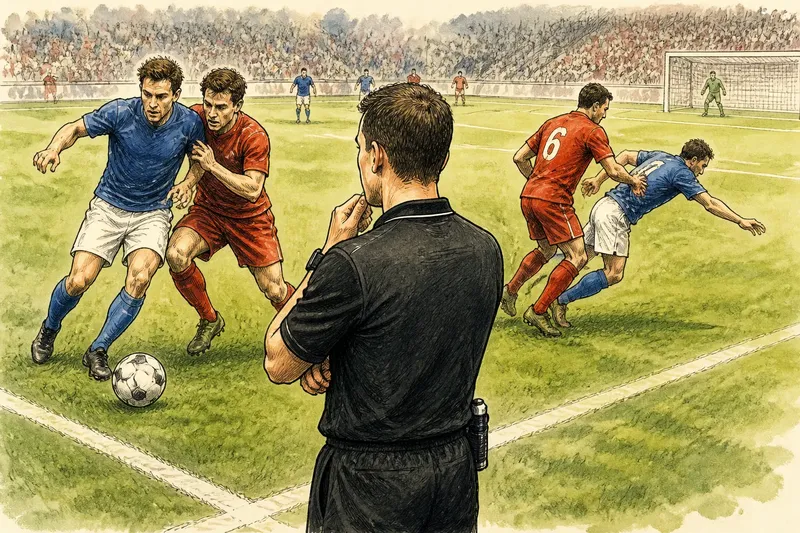
The common mistake in judging a referee is to compare two calls by their appearance alone: one player was penalised, so surely the next player must be penalised in the same way. That expectation can make a sound decision look biased, and it can obscure the more useful question: did the official apply the same rule to the relevant facts? Fair refereeing depends on consistent application, not on making every moment look equal.
Consistency means using the same rule, not copying the same outcome
A rule sets a boundary for play. It may describe an action that is prohibited, a condition that must be met, or a consequence that follows when a breach occurs. The referee’s task is to decide whether the situation before them fits that rule, then apply its consequence. If the situations differ in a way the rule recognises, different decisions may be consistent.
Consider a rule against holding an opponent. A brief touch while both players contest position may not restrict movement; a sustained grip that prevents an opponent from reaching the ball may do so. Both incidents involve hands on a player, but the relevant facts are not identical. Calling each one the same way would treat a visible detail as more important than the behaviour the rule is meant to address.
This distinction does not make consistency subjective or optional. Officials should use the same standard for each side, and their decisions should follow the sport’s rules rather than a preference for a particular team, player or style. But sameness belongs in the standard, not necessarily in the decision produced by applying it.
The rule’s wording defines which differences matter
Rules often distinguish between actions that look alike from the stands. An offence may depend on where an action occurred, whether the ball was in play, whether contact affected an opponent, or whether a player had a lawful opportunity to act. Those details are not excuses added after the event; they are part of what the referee has to assess.
For that reason, a replay or a spectator’s view may not settle the question. A camera can make contact easy to see while leaving its effect unclear. From another angle, a player may appear to have space that was blocked from the official’s position. The relevant issue is not simply whether something happened, but whether it satisfies the rule’s conditions.
Rules also differ in how much judgement they require. Some set a relatively clear condition, such as whether a restart took place from the designated area. Others ask an official to assess matters such as unfair advantage, deliberate action or the seriousness of contact. In those cases, consistency means using a stable interpretation of the standard, even though borderline decisions will not always be obvious to spectators.
Context helps explain a decision without excusing inconsistency
Context matters only where the rules make it relevant. An official may need to consider the players’ positions, the phase of play, the available space or the effect of an action. The speed and pressure of competition can make those details difficult to judge, but they do not give a referee permission to invent a different rule for a promising attack or a favoured player.
Suppose a defender makes contact with an opponent who is already moving away from the ball. The same contact in another situation might have little effect, while here it could prevent a clear attempt to continue play. If the sport’s rule treats that effect as relevant, the different outcome follows from applying one standard to different circumstances. It is not fairer to ignore the effect merely to make the two calls resemble each other.
Imagine a fictional match in which a referee first allows a light shoulder-to-shoulder contest because both players remain able to challenge for the ball. Later, the referee penalises a similar-looking collision after one player drives through an opponent who has lost position and cannot continue the contest. The expected observable difference is that play continues in the first instance and stops in the second, because the contact’s nature and effect differ under the rule. If the sport defines both incidents as lawful, however, the second call would need another rule-based reason.
Why can the same-looking incident receive a different call?
Does the referee have to call every similar contact?
No. The official must judge whether each incident meets the rule’s threshold, not whether it resembles a previous moment at a glance. A difference in force, timing, position or effect may matter if the rules make it relevant.
Does a previous call set the standard for the rest of the match?
Earlier decisions can help players and spectators understand how the referee is interpreting a judgement-based rule. They do not turn an earlier error into a rule, and an official should correct an interpretation rather than repeat it simply for the sake of apparent symmetry.
Can a referee treat both teams differently while applying one rule?
The same rule applies to both teams, but different actions can produce different consequences. A pattern of comparable incidents being judged differently may raise a fair question about consistency; one pair of calls cannot answer it without comparing the facts the rule considers.
Why do spectators disagree about a decision?
People may see different angles, attend to different details or understand the rule’s threshold differently. The disagreement becomes clearer when it is framed around the rule’s conditions—what happened, what effect it had and which part of the rule applies—instead of around the teams’ identities.
Consistency has limits when judgement is unavoidable
Some rules leave room for interpretation because the same visible action can have different consequences. An official may judge whether contact was careless, whether a player gained an advantage or whether an infringement materially affected play. The rule’s wording and the sport’s established interpretations guide that decision, but judgement cannot be removed from every case.
That discretion should still be disciplined. A referee ought to use the same threshold across the match, avoid changing it to manage the score, and distinguish between a genuinely different incident and one that merely feels inconvenient to call. Players, in turn, may reasonably expect the standard to remain recognisable even as the details of play change.
Discretion is not a licence to choose whichever outcome feels balanced. If a referee overlooks an offence early on, the answer is not to overlook a comparable offence later so both sides have received the same favour. Each decision should be judged against the rule, while any pattern of mistakes is considered as a pattern rather than disguised as fairness.
Players read the standard through its practical effects
Players often adapt to what an official permits, especially where the rule leaves a judgement call. A referee who consistently penalises contact that restricts an opponent gives both teams a usable boundary. An official whose threshold shifts unpredictably leaves players guessing, even if each decision can be defended in isolation.
This is one reason communication matters. A short, calm explanation can clarify what the referee judged—such as holding, obstruction or an infringement affecting play—without turning the match into a debate after every stoppage. The explanation should connect to the rule, not promise that a similar-looking incident will receive an identical call regardless of its circumstances.
For players, the practical response is to attend to the boundary rather than hunt for a loophole in one missed call. If the referee has consistently penalised a particular form of contact, continuing to use it because it went uncalled once is a poor reading of the standard. If the interpretation is unclear, a captain can seek clarification through the sport’s usual process.
Judging a referee means comparing the right details
When assessing consistency, compare incidents by the facts the rule makes important. Ask whether the same action occurred, whether it had a similar effect, whether the players were in comparable positions, and whether the rule’s conditions were met. A side-by-side comparison of outcomes alone can make different incidents appear equivalent.
It is also useful to separate an isolated mistake from a pattern. Officials can miss an event or misjudge a close call; that does not establish that they have abandoned the rule. Repeatedly applying different thresholds to comparable actions is more telling, particularly if the distinction tracks team identity rather than a relevant feature of play.
Understanding fair refereeing therefore begins with the rule’s purpose and wording, then turns to the details of each decision. The most useful question is not, “Did the other side receive the same call?” but, “Did the same standard govern both incidents?” That is the heart of consistent rule application: not a promise of identical-looking outcomes, but a dependable basis for judging what happened.
Next time a call seems uneven, listen for the distinction the referee is applying and compare it with the rule. Fairness becomes easier to assess when the conversation moves from matching outcomes to examining reasons—and when a genuine inconsistency is named plainly rather than excused as balance.